



NOTICE
Presentation
Dates: March 9th and 13th, 2026
Time: 8 AM to 6 PM
Location: FINATEC - Brasília - DF
ABOUT JBIS-WESP 2026: HISTORY, MOTIVATIONS AND OBJECTIVES
Brazil's interest in Space Electric Propulsion dates back to the late 1970s and early 1980s, when the MECB (Complete Space Mission) was still being initiated. The first ideas emerged at that time from bibliographic research and discussions among specialists in the field of Physics and Plasma Technology. The interaction between researchers and technicians from INPE, ITA and IEAv/CTA in the area was fundamental for the emergence of the first electric thruster development projects.
The Associated Plasma Laboratory (LAP) of INPE was responsible for the development of the first prototypes of ELECTRIC THRUSTERS. PION I in 1985 and PION II and III in the 90s. In 1989, PION was proposed to be tested on SCD2 (Data Collection Satellite 2) (Sandonato G.M.; Montes A.; Ludwig G.O.; Ferreira J.G. and Ferreira J.L., in Proposal for an Experiment on Board the 2nd Data Collection Satellite - SCD 2 of MECB; November 1989).
The mission limitations did not allow the implementation of the electric thruster on the SCD2. However, interest in the area remained, and in 1996 a new proposal was made to place the PION II on the SSR (Remote Sensing Satellite), which was also not implemented because the satellite project did not continue.
The other Brazilian institution that started research in the area of propulsion was the Physics Institute of the University of Brasília (UnB), in the Plasma Physics Laboratory (LFP). Initially, from 1994, experimental work was oriented towards the development of Kaufmann-type ion sources. In a later phase, from 2002, Hall-type Plasma Thrusters began to be developed with the support of the UNIESPAÇO PROGRAM of the AEB.
One of the main positive consequences of the projects supported by the UNIESPAÇO program in Brazil was the increase in the training of undergraduate and graduate students in the space sector throughout the country. It is important to emphasize that this program was fundamental for the implementation, improvement, and strengthening of the space sector at UNB (University of Brasília). In 2012, the undergraduate course in Aerospace Engineering was created at the current FCT/UnB (Faculty of Science and Technology of the University of Brasília) in Gama. Subsequently, in 2020, a specialization course in Astrophysics and Space Environment was implemented at IF/UnB (Institute of Physics of the University of Brasília).
Historically, starting in 2008, other research groups in electric propulsion began operating in Brazil, mainly at the Propulsion and Combustion Laboratory (LCP) of INPE in Cachoeira Paulista - SP. The LPEL - Electric Propulsion Laboratory was created, and at UnB, the Advanced Propulsion Laboratory (LPAv) of the Aerospace Engineering course at the Faculty of Technology of Gama FGA/UnB was established. In that same year, a proposal for a DEEP SPACE MISSION stimulated and motivated the groups involved with electric propulsion. The ASTER Mission to a triple asteroid system using electric propulsion was intensely studied and discussed, but unfortunately, it did not receive support for its realization.
In 2008, the "Brazilian Electric Propulsion Network" was established, and the FIRST BRAZILIAN SCHOOL OF SPACE ELECTRIC PROPULSION was created and organized at INPE in 2008. The event took place between July 1st and 11th, 2008, and the program covered the following topics:
- Space Missions
- Orbital Dynamics
- Chemical Thrusters
- Electric Thrusters
- Advanced Propulsion
- Space Systems Engineering
The classes were taught by national and international professors and researchers.
The NATIONAL professors were Dr. Gilberto M. Sandonato (LAP-INPE), Prof. José Leonardo Ferreira (LFP-IF-UnB), Rodrigo Marques Intini (LCP-INPE), Paolo Gessini (at the time at INPE), Marco Antonio S. Mineccuci (IEAv-CTA) and Fernando de Souza Costa (LCP-INPE).
The INTERNATIONAL participants were Dr. Edgar Choueiri (Phys. Inst.-Princeton, USA), Dr. Cristina Bramanti (ESA), Dr. Ismat Rudwan (Qinetic, UK), Dr. Neil Wallace (Qinetic, UK), Dr. Roger Walker (ESA), and Prof. Stephen Gabriel (Univ. of Southampton, UK).
However, despite collaborations between groups, the research proceeded along essentially independent lines. The lack of industry involvement was also a factor inhibiting the development of the area in Brazil.
The last event in this area was an Electric Propulsion Workshop organized in 2019 at INPE in São José dos Campos, São Paulo. The event was organized by the then Director of the Satellite and Space Platform Area of INPE, Dr. Marcos Chamon, current President of the Brazilian Space Agency (AEB). The event was important to re-establish the discussion on the subject. At the time, there was a lack of a new forum for the area of Electric Propulsion, where discussions and presentations of research and technologies could point to the perspectives of the area in Brazil. The FIRST ELECTRIC PROPULSION WORKSHOP in Brazil took place in 2019. It was broad, because unlike the 1st ELECTRIC PROPULSION SCHOOL, it had a large participation not only from the academic area but mainly from the Aerospace Sector industries. Several projects and studies were presented, which allowed for technical discussions among the different national actors in the sector.
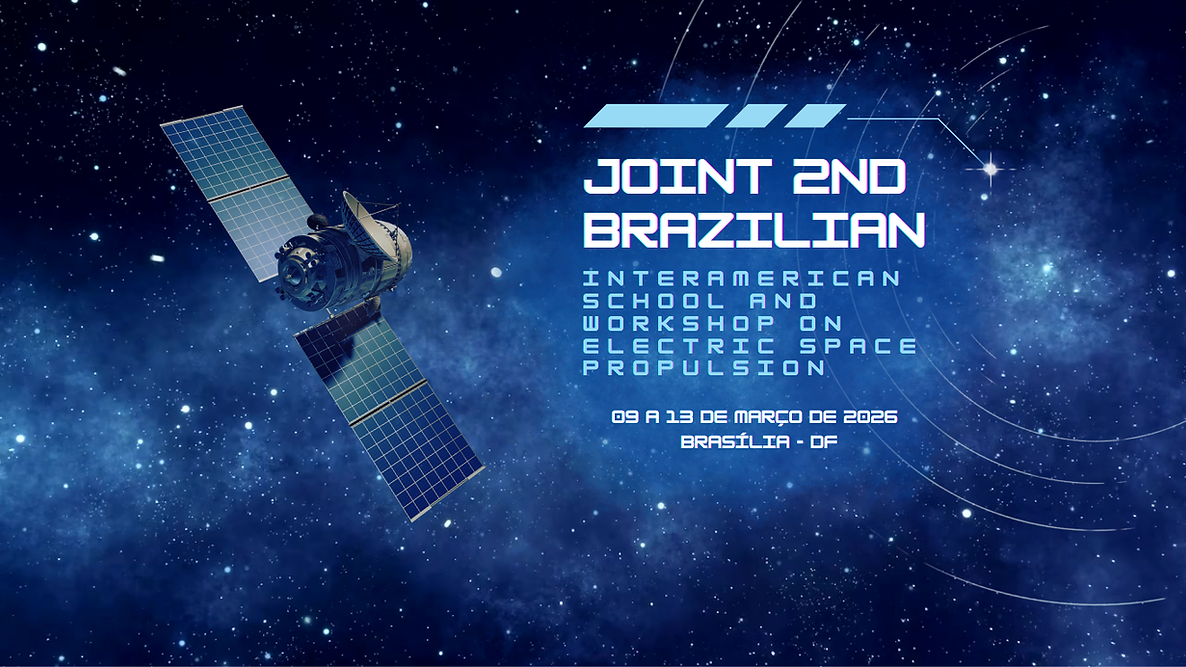
The 2nd Brazilian School and Workshop on Electric Space Propulsion in Brazil have been combined to hold the 2nd Brazilian / Inter-American School and Workshop on Electric Space Propulsion, JBIS-WESP 2026, which will take place between March 9 and 13 at FINATEC located in Brasília-DF, on the UnB Campus in the north wing.
The objectives of JBIS-WESP will be:
- To contribute to the training of personnel for the space sector with a special focus on the training of researchers and technicians for the specific area of electric space propulsion.
- To create a permanent forum for discussions and ideas among researchers and technicians in the field in Brazil, involving professionals from Universities, Technical Schools, Research Institutions and Companies in the Aerospace Sector.
- To enable interaction between researchers from the international community in the field with national researchers and technicians, also seeking to especially stimulate researchers from Latin America involved in the space sector.


Target audience
-
Undergraduate students
-
Graduate students
-
Professors, researchers and professionals

Submission: February 9th to 27th, 2026 - APPROVED WORKS
Result announcement: 03/03/2026 (Acceptance emails will be sent to the author who submitted the work; please check your inbox. If you have any questions, please contact us by email (spacepropulsion.unb@gmail.com) or by WhatsApp (61) 99639.7003)

Submission of Works
GUIDELINES
-
The works will be presented in poster format.
-
For more information/general questions, please contact us: spacepropulsion.unb@gmail.com. The response time is 48 business hours.
-
All communication with authors will be via email.
-
Works should be submitted in ".pdf" format and according to the guidelines provided on the side. CLICK HERE.
-
Identify the work with its title.
-
If your work is approved, you will receive an email informing you. After receiving the email, your work should be formatted according to the poster template below.
-
Click the "Submission" button, fill out the form and attach your work.
Poster (template - click here)
-
The authors are responsible for creating and printing the poster;
-
Poster framing area: 0.90 x 1.20 m;
-
Create a visually clean poster without excessive details;
-
Use a legible font size;
-
The poster will be displayed on a tripod-type banner stand, requiring the fabrication of a rod and string for hanging.
-
If, for any reason, you are unable to attend, please contact your co-author to take over the poster presentation or inform the organizers of your absence as soon as possible by email: spacepropulsion.unb@gmail.com.
Preliminary
Programming
MORNING
08h00 - 09h00
|
Opening Ceremony
09:45 - 10:00
|
COFFE BREAK
10:00 - 11:00
|
Status of Electric Propulsion
Prof. Michael Keidar (GWU)
Chair: José Leonardo Ferreira
11:00 - 12:00
|
11:00 - Electric Propulsion in Brazil
Prof. Paolo Gessini (AEB)
11:30 - Research in Space Electric Propulsion at INPE
Rodrigo Intini Marques (INPE)
Chair: José Leonardo Ferreira
12:00 - 15:00
|
LUNCH - FINATEC
AFTERNOON
15:00 - 16h00
|
Discrete Unified Gas Kinetic Scheme for MHD Flows - an Implementation in Open FOAM
Prof. Juan Pablo Salazar (UFSC)
Chair: Rodrigo Miranda
16:00 - 16:15
|
Title TBD
Prof. Argemiro Sobrinho (ITA)
Chair: Rodrigo Miranda
16:15 - 17:10
|
Welcome Drinks

CONFIRMED ATTENDEES


José
Leonardo
University of Brasília - UNB

Rodrigo
Miranda
University of Brasília - UNB

Our
Experiments


SUPPORT
REALIZATION
Desenvolvido por


